 English
 Russian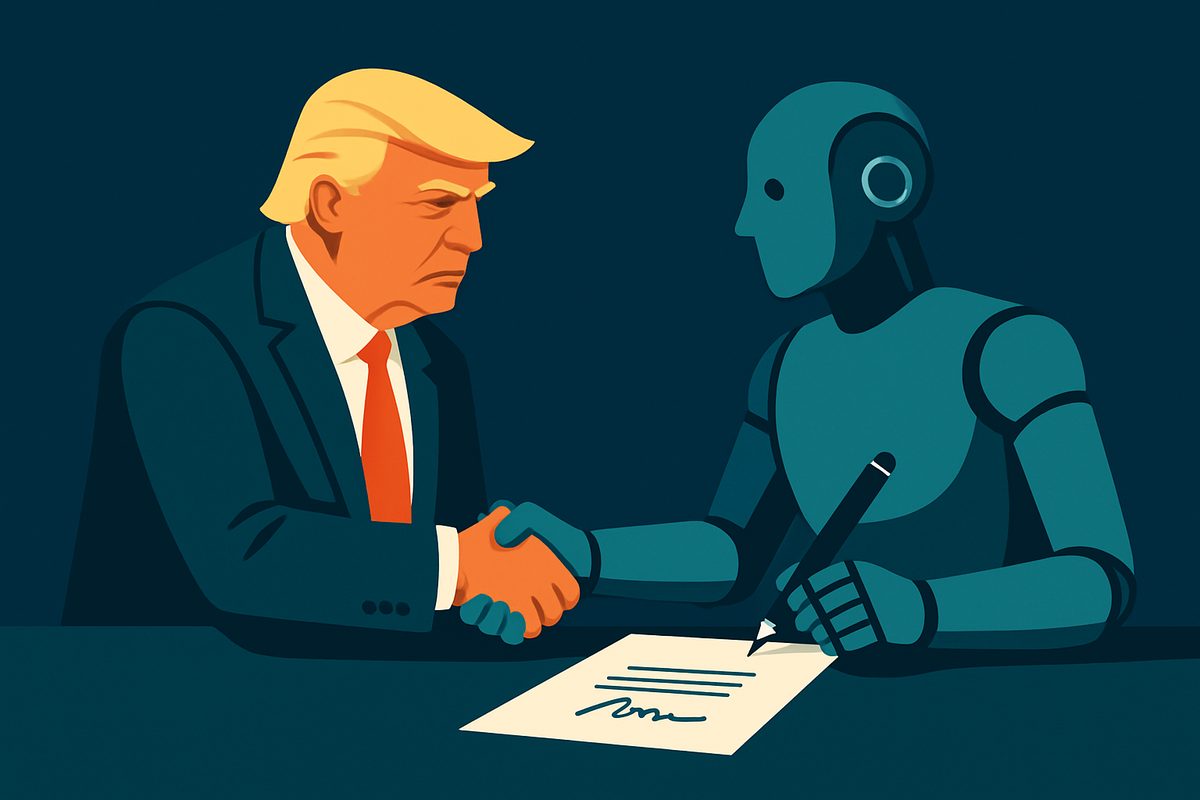
Donald Trump and executives from leading AI companies signed a voluntary safety code on September 29, focusing on internal controls, independent audits, and oversight. The document does not introduce a collective pause in development. Meanwhile, Goldman Sachs estimates that five American hyperscalers will invest up to $800 billion in AI this year.
Trump opposes slowing development, arguing that restrictions would benefit China and warning: “Don’t kill the Golden Goose!”. The President also announced the creation of a “Super Intelligence Force” led by former SEC Chairman Jay Clayton.
Anthropic Proposes 'Pacing the Frontier,' Industry Leaders Express Support
Anthropic CEO Dario Amodei proposed in September to slow the progress of the most advanced models to allow safety research to keep pace: independent evaluators within labs, shared standards, and limits for developers in democratic countries, followed by international coordination, including with China. The approach was supported by Sam Altman (OpenAI), Google DeepMind co-founder Demis Hassabis, and Elon Musk (xAI).
Bill to Ban Superintelligence Introduced on September 23
Senator Bernie Sanders and Representative Greg Casar introduced the “Ban Artificial Superintelligence Act,” which would permanently prohibit superintelligence and halt advanced AI development until federal rules are established. Senator Elizabeth Warren supports an immediate pause, while European Commission President Ursula von der Leyen advocates for “pacing” frontier research.
SoftBank Increases Funding for OpenAI; AI's Contribution to U.S. GDP Growth
SoftBank issued additional bonds totaling $10 billion and €1 billion ($1.15 billion) for investments in OpenAI; by the end of July, the company had invested about $54.6 billion. The deal was the largest among non-financial corporations in the Asia-Pacific region and Japan, and ranked among the 20 largest globally this year. According to a January analysis by the St. Louis Fed, broad AI investment contributed 0.97 percentage points to real GDP growth in the first three quarters of 2025—39% of total growth (36% excluding data centers), compared to 28% in 2000.
Nvidia CEO Jensen Huang calls for rapid development, allowing for company-level pauses in case of risks; Mark Zuckerberg supports self-regulation by labs. A potential slowdown in AI may not necessarily lead to an economic crisis in the U.S., but would significantly affect expectations and investment dynamics.